


XPS Network and KINEXON Sports announce new API integration
A new connection brings KINEXON Sports player-tracking data into customizable XPS Reports, allowing coaches, performance staff and sports directors...
Read More
August 21, 2026
15 min reading
In soccer, recovery is often viewed simply as the time between training sessions or matches. In reality, recovery is an essential part of the performance process. It is the bridge between the stimulus created through training and the adaptation we want the athlete to achieve.
Recovery modalities are strategies used to help athletes restore physical and psychological readiness following training or competition. Common approaches include sleep, nutrition, hydration, active recovery, cold- and hot-water immersion, massage and compression. Their effectiveness depends on the athlete, the training objective, the workload, and the time available before the next performance.
Most coaches understand the basic principle: train → recover → adapt. Yet recovery is often the least deliberately planned part of the process. If we want athletes to consistently adapt to training, we need to create the conditions that allow recovery to occur.
That does not necessarily mean adding more recovery tools, buying the latest technology, or filling the schedule with additional interventions. It means making sure recovery strategies are appropriate for the training objective, the competition schedule, and the individual athlete.
Before discussing ice baths, compression garments, massage, or other recovery technologies, coaches and performance staff should first focus on the fundamentals.
One of the most common mistakes in modern sport is looking for advanced recovery solutions before the basics are consistently addressed. Recovery boots, massage guns, supplements, cold-water immersion, and other modalities can have a role within a performance program, but they cannot compensate for consistently poor sleep, inadequate energy intake, insufficient carbohydrate availability, or poor hydration.
Think of recovery as a pyramid. The foundation is built on sleep, nutrition, hydration, and appropriate training load management (Nédélec et al., Sports Medicine, 2013). Everything else sits on top of these foundations.
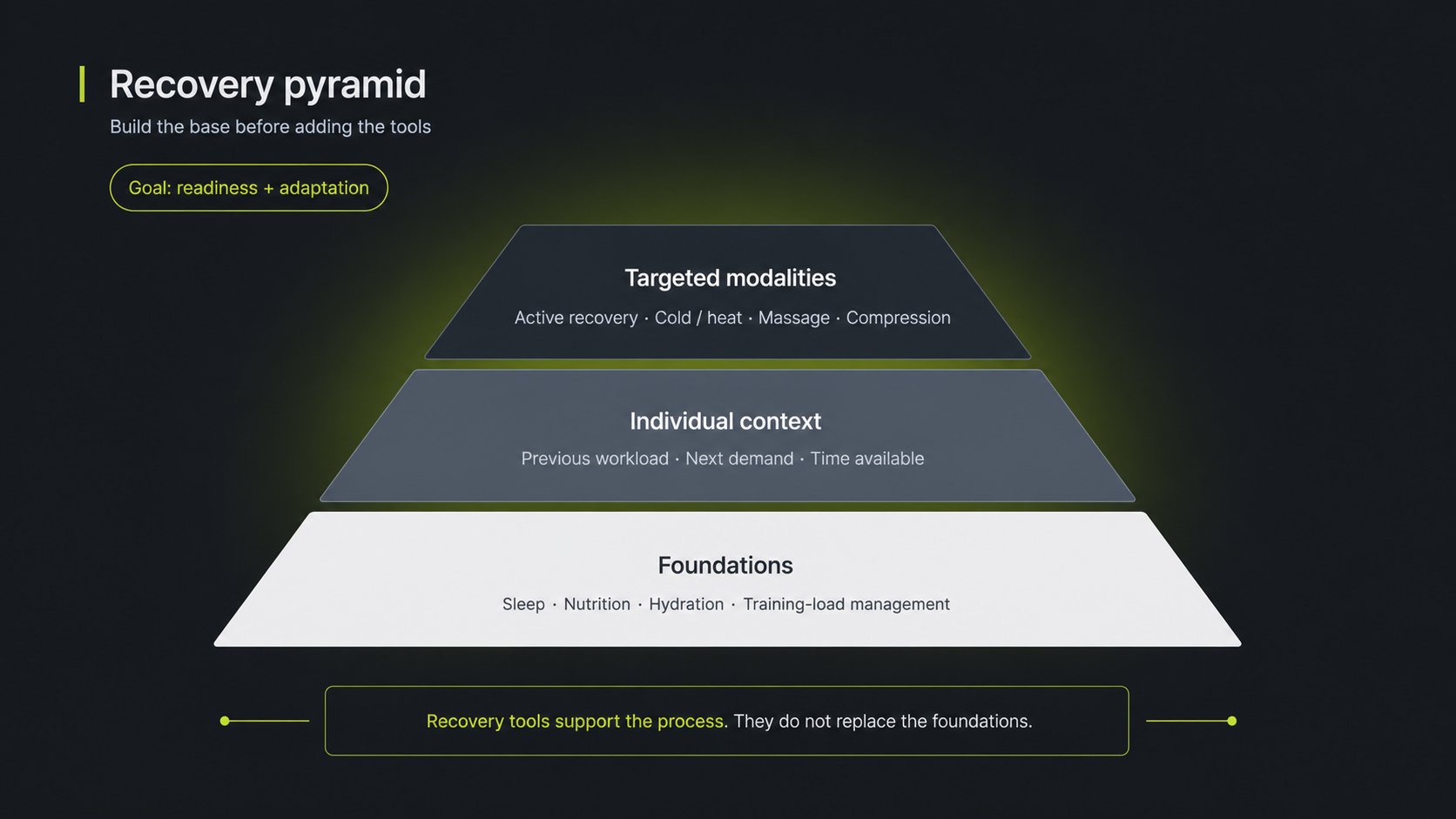
Sleep should be considered one of the highest priorities in any athlete recovery strategy. During sleep, the body supports tissue repair, hormonal regulation, immune function, memory consolidation, and restoration of physical and cognitive function. The goal should not simply be to tell athletes to “sleep more.” Coaches and performance staff should help create an environment where athletes can consistently achieve sufficient, high-quality sleep, particularly during congested competition periods, travel, early training sessions, or periods of increased psychological stress.
Nutrition is equally important. Training creates physiological stress that requires adequate resources to recover from and adapt to. Adequate energy intake, sufficient protein, appropriate carbohydrate availability, and good overall dietary habits are fundamental to the recovery process. Carbohydrate availability becomes particularly important when athletes need to restore glycogen quickly between demanding sessions or matches.
Hydration is another simple but important component of recovery. Athletes can lose significant amounts of fluid during training and competition, particularly in hot or humid environments. Failing to replace these losses can leave an athlete starting the next session already compromised. Recovery should therefore begin as soon as training or competition finishes, with fluid and, when appropriate, electrolyte replacement becoming part of the team’s normal post-training routine.
Only once these foundations are consistently addressed should coaches begin asking which additional recovery modalities may provide value.
There is no single “best” recovery modality for every athlete or situation. The most effective recovery strategy starts with the fundamentals: adequate sleep, appropriate nutrition, hydration, and sensible training load management.
Additional strategies such as cold-water immersion, active recovery, massage, compression, and heat can then be used strategically according to the athlete’s needs, the demands of the previous session, and the time available before the next performance.
The important distinction is that a recovery modality is a tool, not the recovery process itself.
Cold-water immersion is one of the most commonly used recovery strategies in elite sport. Its main practical benefit appears to be a reduction in perceived muscle soreness and fatigue (Dupuy et al., Frontiers in Physiology, 2018), with athletes often reporting that they feel fresher following demanding exercise.
This can make cold-water immersion particularly useful when athletes have limited time to recover between matches. Research in professional football suggests that cold-water immersion may help some aspects of short-term recovery following competition (Querido et al., International Journal of Sports Physiology and Performance, 2022), although the effects are not consistent across every measure of performance. Individual responses also vary, meaning coaches should avoid treating cold-water immersion as a universal solution.
Context is therefore critical.
If the objective is to help an athlete feel better and be ready to perform again within a short period, cold-water immersion may be an appropriate strategy. If the objective is to maximize long-term strength or hypertrophy adaptations, however, frequent use immediately after resistance training may not always be desirable. Some research suggests that regular post-exercise cold exposure can attenuate certain training adaptations (Malta et al., Sports Medicine, 2021).
The important question is therefore not simply, “Does cold water work?” The better question is, “Is cold water appropriate for what we are trying to achieve right now?”
Recovery strategies should support the training objective, not automatically override it.
While cold-water immersion receives most of the attention, heat-based recovery strategies can also have a place within a performance program. Hot-water immersion may promote relaxation, increase peripheral blood flow, and improve an athlete’s perception of recovery and wellbeing.
For coaches, its value may therefore extend beyond simply reducing muscle soreness. Recovery is not exclusively physiological. Psychological stress, competition pressure, travel, and poor sleep can all influence an athlete’s ability to recover.
Sometimes an effective recovery intervention is simply one that helps an athlete transition from a highly stimulated state to a more relaxed one. This may be particularly relevant following evening matches, long travel days, or periods of high psychological stress.
The evidence surrounding heat-based recovery is still developing, but it remains a potentially useful tool when applied within the appropriate context.
Active recovery remains one of the most practical and accessible strategies available to coaches. A low-intensity bike session, pool session, mobility circuit, or light aerobic activity can provide athletes with an opportunity to move without creating significant additional training stress.
Active recovery may help reduce feelings of stiffness and improve an athlete’s perception of readiness, while also providing structure to the recovery period following a demanding match or training session.
The key, however, is intensity. An active recovery session should facilitate recovery, not become another training session.
This is where the performance coach plays an important role. The content, duration, and intensity should be adjusted according to the athlete’s previous workload, current fatigue, upcoming training demands, and competition schedule.
Compression garments and massage are widely used across professional and elite sport (Hill et al., British Journal of Sports Medicine, 2014). Their physiological effects can vary depending on the intervention and context, but both can contribute to athletes’ perception of recovery.
Compression may be particularly useful during travel or between successive performances, while massage can provide relaxation and help athletes feel physically prepared for the next session.
These psychological effects should not be dismissed. If an intervention helps an athlete feel more relaxed, confident, and ready to perform, it may have practical value within the overall recovery strategy.
Research in professional football suggests that massage and cold-water immersion may be particularly useful for improving perceived recovery (Querido et al., International Journal of Sports Physiology and Performance, 2022), even though evidence for consistently improving all physical and physiological measures is less convincing.
Compression and massage should therefore be viewed as supporting tools rather than essential components of recovery. They should complement the fundamentals rather than replace them.
For soccer coaches, recovery decisions should be closely linked to the time available before the next performance. A player recovering from a match with 24 hours before the next game requires a different approach from a player who has four or five days before the next competition.
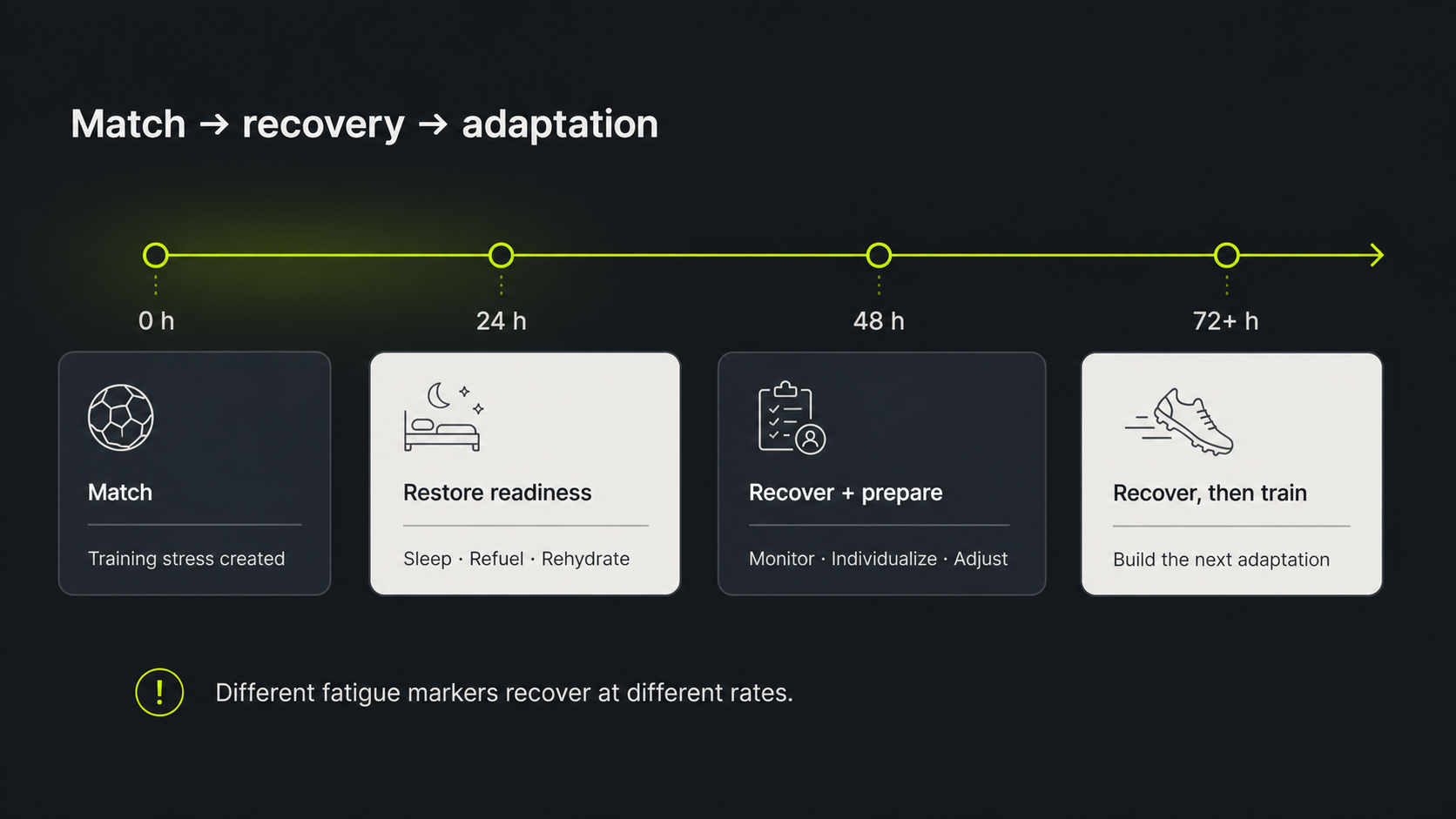
Research shows that different aspects of soccer match fatigue recover at different rates. Some performance measures may recover relatively quickly, while muscle soreness and other markers of fatigue can remain altered for 48–72 hours or longer (Silva et al., Sports Medicine, 2018).
This is why recovery should not be treated as a simple one-size-fits-all process.
When the next match is less than 48 hours away, the priority should generally be restoring readiness rather than creating additional training adaptations.
The immediate focus should be on sleep, nutrition, rehydration, and reducing unnecessary physical stress. Low-intensity movement can be used when appropriate, while modalities such as cold-water immersion or massage may be added when they help the athlete feel ready for the next performance.
In this situation, the question for the performance staff is:
“How can we help this athlete be ready to perform again as quickly as possible?”
With approximately 48 hours between matches, there is more opportunity to individualize the recovery process.
Players may still benefit from active recovery, mobility, nutrition, hydration, and selected recovery modalities. At the same time, the performance staff can begin transitioning from recovery toward preparation for the next training stimulus.
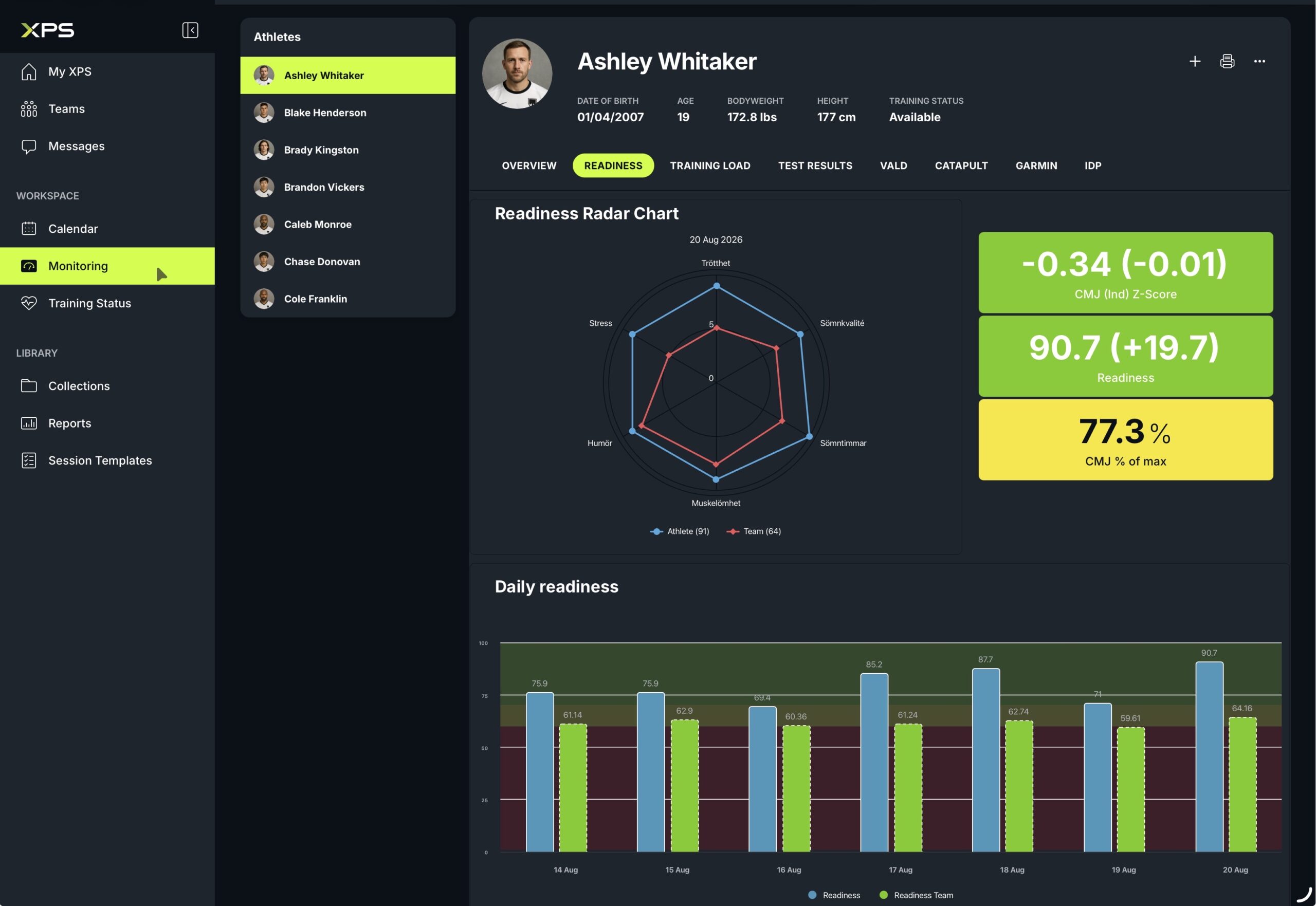
Monitoring tools such as wellness questionnaires, CMJ testing, GPS-derived workload, or other readiness measures can help determine whether the athlete is recovering as expected and whether the next training stimulus should be modified.
That is where a monitoring view becomes useful. In XPS Network, readiness reports can bring wellness inputs and test results into one athlete profile, compare the individual with team trends, and show how the picture changes over time. The numbers do not make the decision for the coach; they add context for deciding whether to maintain the plan, reduce the next load, or move back toward normal training.
When 72 hours or more are available, the emphasis can progressively shift from recovery toward adaptation and preparation.
Players may have sufficient time to recover fully and then complete meaningful training before the next match. This highlights an important principle:
More recovery time does not necessarily mean more recovery modalities. It may instead mean more opportunity to train appropriately.
The objective is not to keep athletes in a permanent state of recovery. The objective is to recover enough to expose them to the next appropriate training stimulus.
A simple decision-making framework can help coaches and performance staff select the appropriate strategy.
First, consider what the athlete has just done. Was it a match, a high-intensity training session, a strength session, or a low-load technical session?
Next, consider what the athlete has to do next. Is the next session a recovery day, a demanding training session, or another competitive match?
Finally, consider how much time is available.
When the turnaround is short, the priority is generally rapid restoration of readiness. When more time is available, there is greater opportunity to balance recovery with continued training and adaptation.
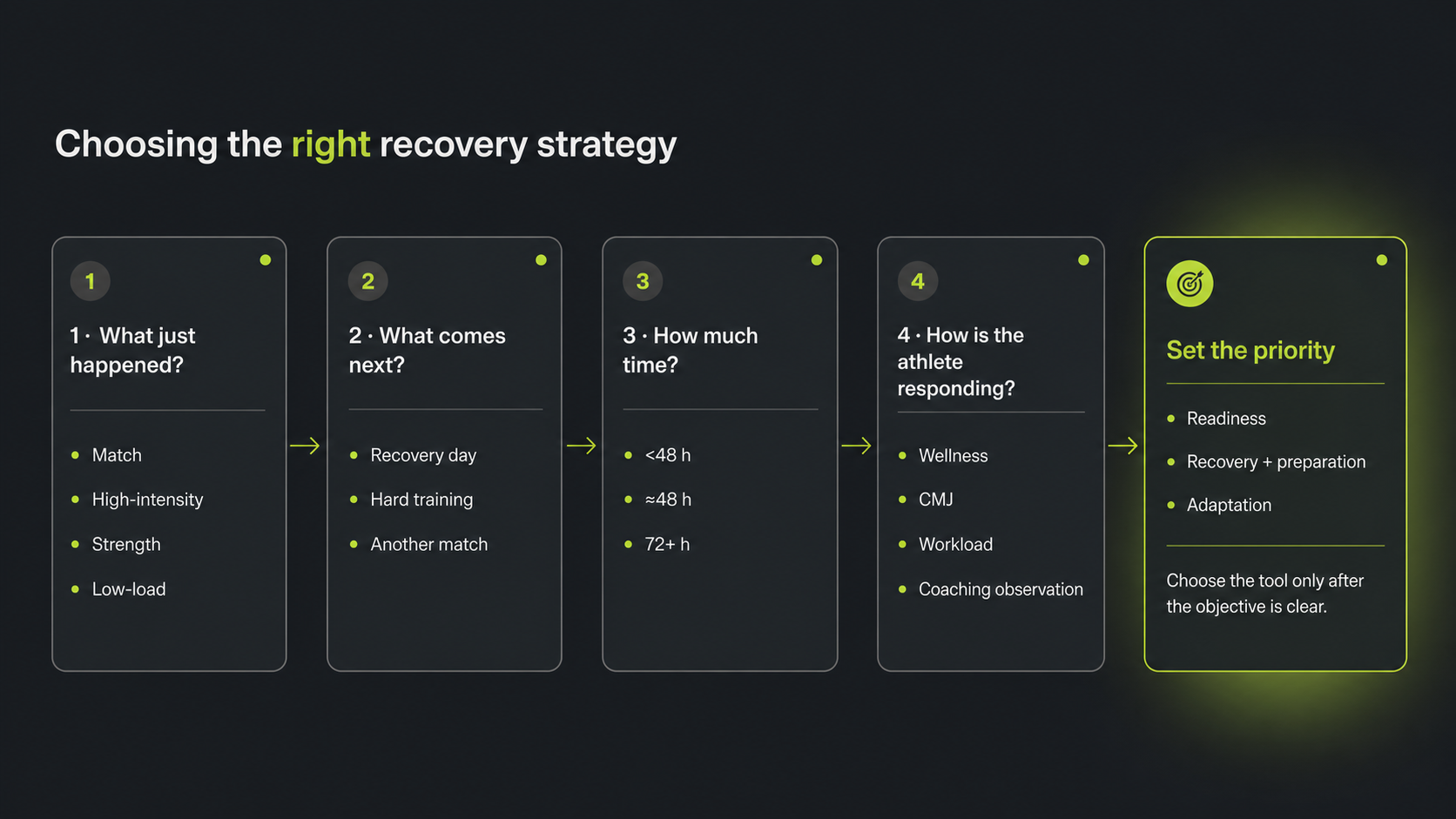
This can be summarized simply:
Short turnaround → prioritize readiness
Approximately 48 hours → prioritize recovery while preparing for the next stimulus
72+ hours → recover, then prioritize training and adaptation
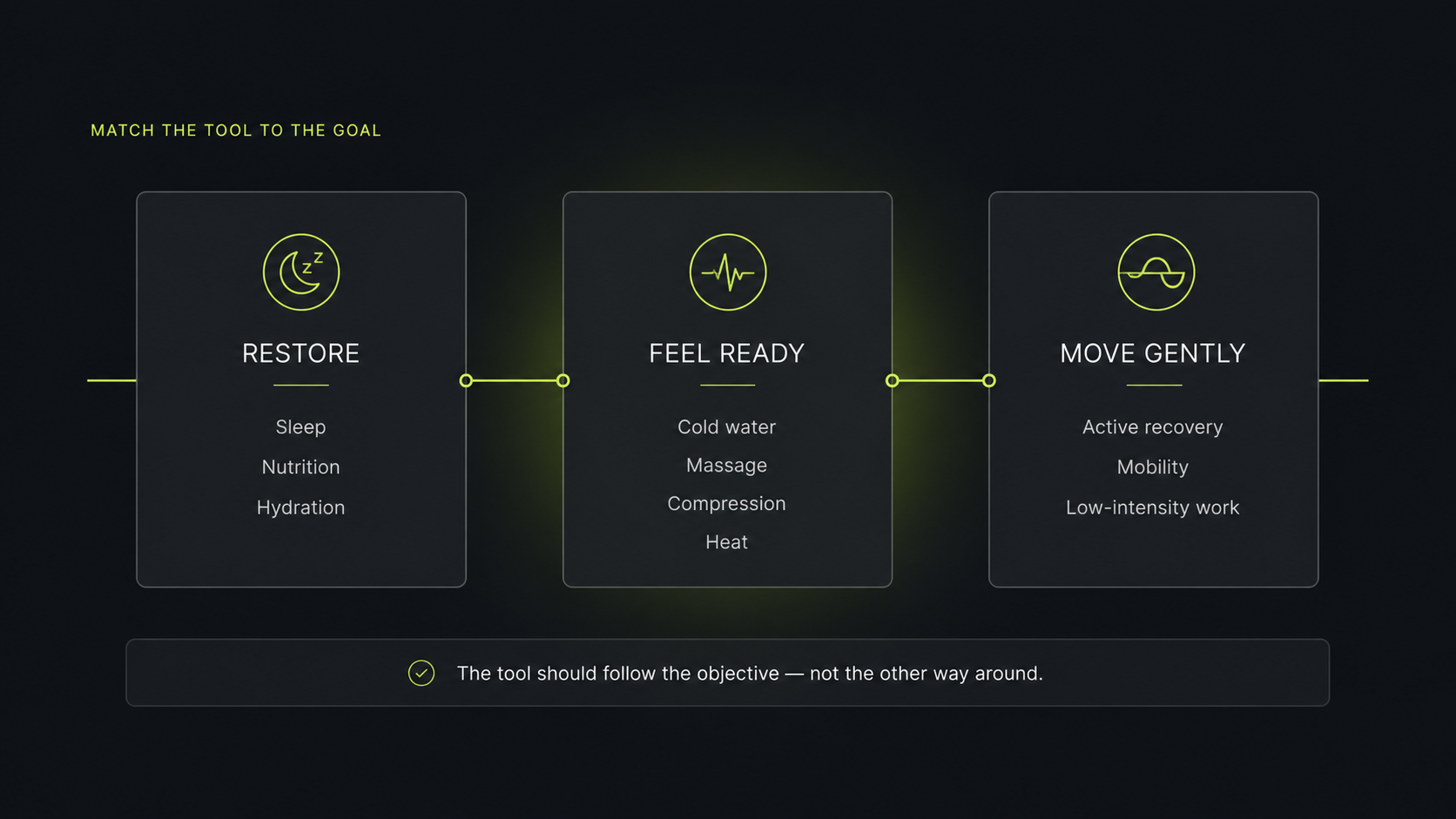
The modality should then match the objective. If the priority is rehydration, the intervention is hydration. If the priority is restoring energy availability, nutrition is the priority. If the athlete needs low-stress movement, active recovery may be appropriate. If the athlete needs to feel fresher before another match, cold-water immersion or massage may be considered.
Once the objective is clear, the intervention still has to be turned into a practical plan. XPS Network session templates allow staff to build repeatable recovery or return-to-training workouts with exercise instructions, sets, reps, and rest, then add the selected session to the athlete’s calendar. The template keeps the process consistent without removing the option to adjust it for the individual.
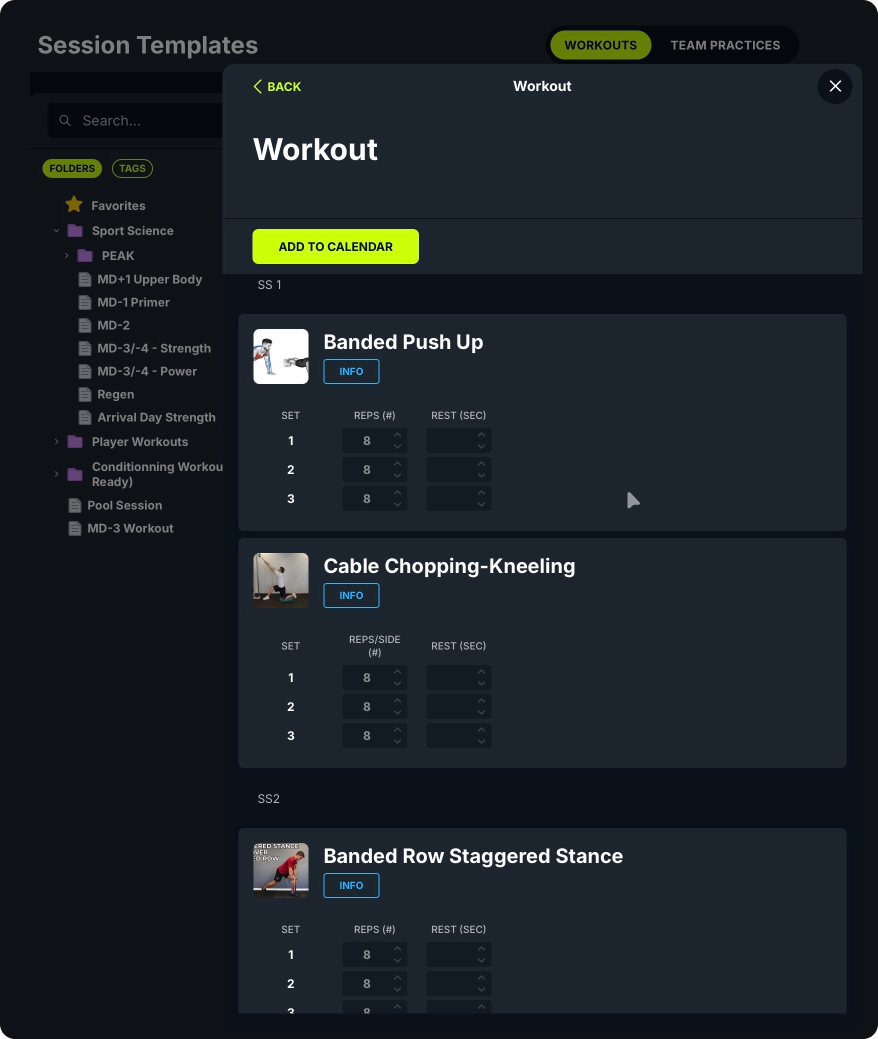
The tool should follow the objective, not the other way around.
Perhaps the most important message for coaches and performance staff is that recovery should be programmed, not improvised.
The appropriate recovery strategy will depend on what the athlete has just done, how much fatigue they have accumulated, what they have to do next, and how much time is available between the two.
The priority may be very different after a demanding match compared with a strength session during a development block.
This is why recovery should be considered part of training design, rather than something that happens after training has finished.
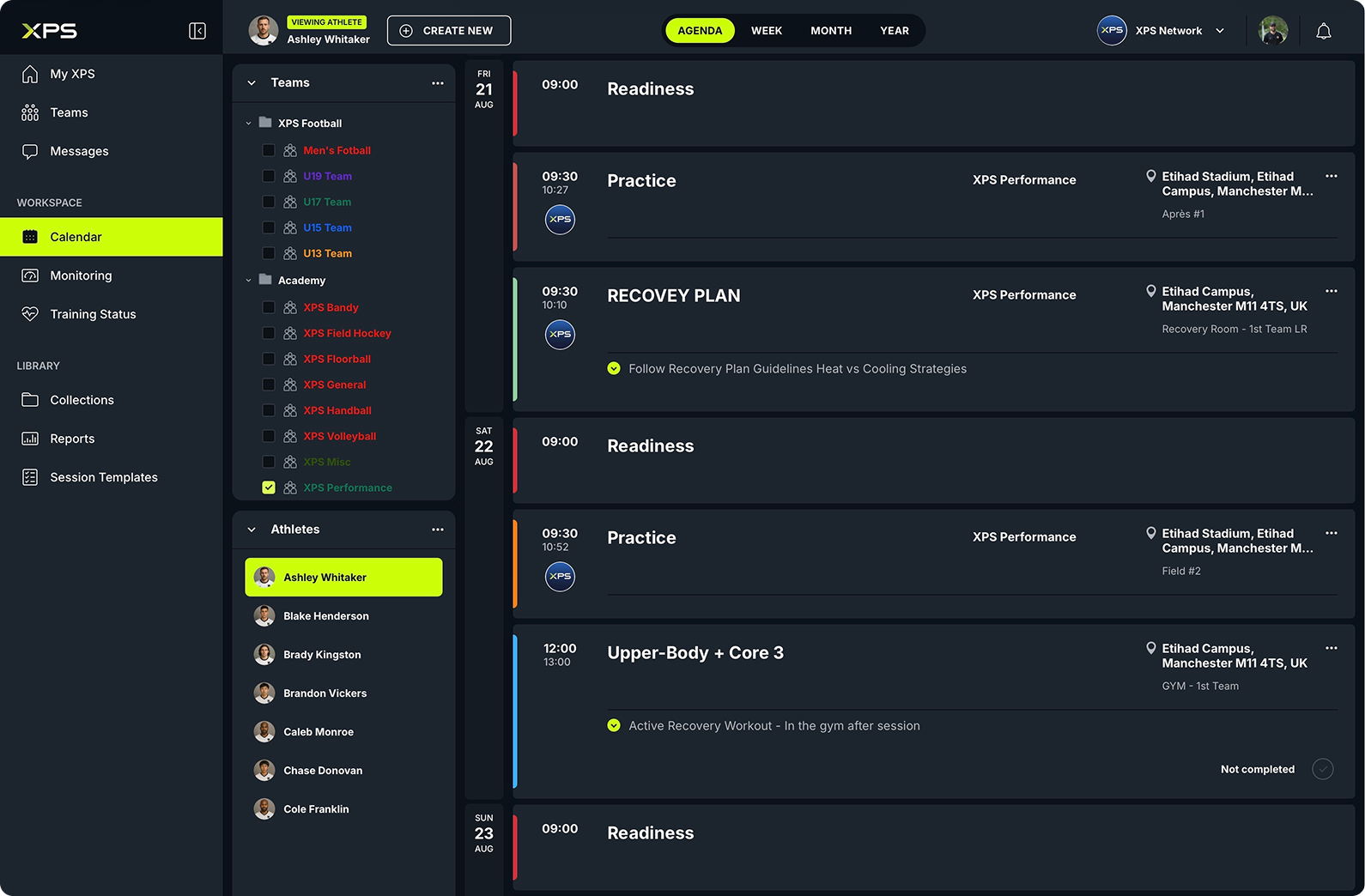
Planning recovery in the same calendar as training makes that intent visible. In XPS Network, a recovery plan can sit alongside practices, readiness checks, and individual workouts, with clear timing, location, guidance, and completion status. Coaches can see what the athlete has done, what recovery is planned, and what comes next, rather than treating recovery as an informal note after the session.
Monitoring can also help guide these decisions. Wellness questionnaires, CMJ testing, GPS-derived workload, heart-rate data, and other monitoring tools can provide information about how athletes are responding. However, these measures should support the decision-making process rather than dictate it.
The goal is not to collect more data. The goal is to use relevant information to make better decisions about training and recovery.
Coaches are ultimately trying to create adaptation. Training provides the stimulus, but the athlete needs adequate resources and appropriate recovery to respond to that stimulus.
Recovery modalities can assist this process, but they are only one part of the equation.
Before asking, “What recovery tool does this athlete need?”, ask whether we have created the conditions for this athlete to recover effectively.
Are they sleeping sufficiently? Are they replacing the energy they are expending? Are they adequately hydrated? Is the training load appropriate? Is there enough time between demanding sessions? And are we considering the athlete’s individual response?
If these questions are being addressed consistently, additional recovery modalities can then be used strategically.
The best recovery strategy is not necessarily the most expensive or the one with the most technology.
Start with the fundamentals: sleep, nutrition, hydration, and appropriate training load management. Then use recovery modalities according to the situation.
Cold-water immersion, hot-water immersion, active recovery, compression, and massage can all have a place within a well-designed performance program. Their value comes from how and when they are used, not simply from having access to them.
For soccer teams, the recovery process should evolve according to the competitive calendar. With a short turnaround, prioritize readiness. With 48 hours, balance recovery with preparation. With 72 hours or more, recover first and then use the available time to train and create further adaptation.
Recovery should be treated with the same level of intent as training.
Because the goal is not simply to help athletes feel recovered.
The goal is to help them recover well enough to adapt, perform, and be ready for what comes next.
And that is where recovery becomes part of performance, not something that happens after it.
What are the most effective recovery modalities for athletes?
There is no single best recovery modality for every athlete. Sleep, nutrition, hydration, and appropriate training load management should form the foundation. Additional strategies such as active recovery, cold-water immersion, massage, compression, and heat can then be selected according to the athlete’s needs and the demands of the next performance.
Are ice baths good for soccer players?
Cold-water immersion can help reduce perceived muscle soreness and fatigue and may support some aspects of short-term recovery following soccer matches. However, its effects vary between athletes and should be considered alongside the timing and objectives of subsequent training.
Should athletes use an ice bath after every training session?
Not necessarily. Frequent cold-water immersion may not always be appropriate when the goal is to maximize certain training adaptations, particularly following resistance training. Coaches should consider whether the priority is short-term recovery or long-term adaptation.
How long does it take to recover from a soccer match?
Different aspects of match fatigue recover at different rates. Some performance measures can recover relatively quickly, while muscle soreness and other markers of fatigue may remain altered for 48–72 hours or longer. Recovery therefore depends on the athlete, match demands, and time until the next performance.
What should soccer players do immediately after a match?
The immediate priorities should be rehydration, appropriate nutrition, beginning the recovery process, and creating an environment that supports quality sleep. Additional strategies such as active recovery, cold-water immersion, or massage can then be considered based on the athlete and competition schedule.
Is active recovery better than complete rest?
Neither is universally better. Low-intensity active recovery can help athletes feel less stiff and support perceived recovery, but the appropriate choice depends on the athlete’s fatigue, previous workload, and demands of the next session.
When should coaches use recovery modalities?
Recovery modalities should be selected according to the objective of the training period. When rapid readiness is required, such as during congested competition schedules, modalities that support short-term recovery may be useful. When the priority is long-term adaptation, coaches should avoid unnecessary interventions that could interfere with the desired training response.
Félix Sauvestre | Sport Science Coach | Canada Soccer
Félix is a Sport Science Coach with over 8 years of experience in professional and developmental football. He currently serves as Performance and Sport Science Manager for Canada Soccer’s Youth Men’s National Team and works with the Institut National du sport du Québec. Previously, he led strength and conditioning and sport science programs at Soccer Québec and CF Montréal’s academy, specializing in athlete monitoring, workload management, and injury prevention.


A new connection brings KINEXON Sports player-tracking data into customizable XPS Reports, allowing coaches, performance staff and sports directors...
Read More
This past weekend, our global sales team came together in Belgrade, Serbia for several inspiring days of conversation, collaboration...
Read More
In one season, Jämtland Basket went from seventh place to the top of the Swedish Basketball League. With Gabo...
Read MoreThank you!
Our representative will get back to you soon with time suggestions for an online meeting.
If you have any questions contact us at support@sidelinesports.com
Schedule a short online meeting with our representative
Try free XPS 14-days trial right now No credit card required


