


British Sailing Pathway: From Youth Sailing to the Olympics
The Royal Yachting Association (RYA) uses XPS Network across the British Sailing Pathway to connect physical testing, athlete development...
Read More
November 24, 2026
10 min reading
A microcycle is a short training block, usually 7 days, that balances match recovery, tactical work and physical preparation for the next game. In team sports it is counted back from match day (MD-), from MD+1 recovery to MD-1 activation, so hard work is placed early and the team arrives fresh.
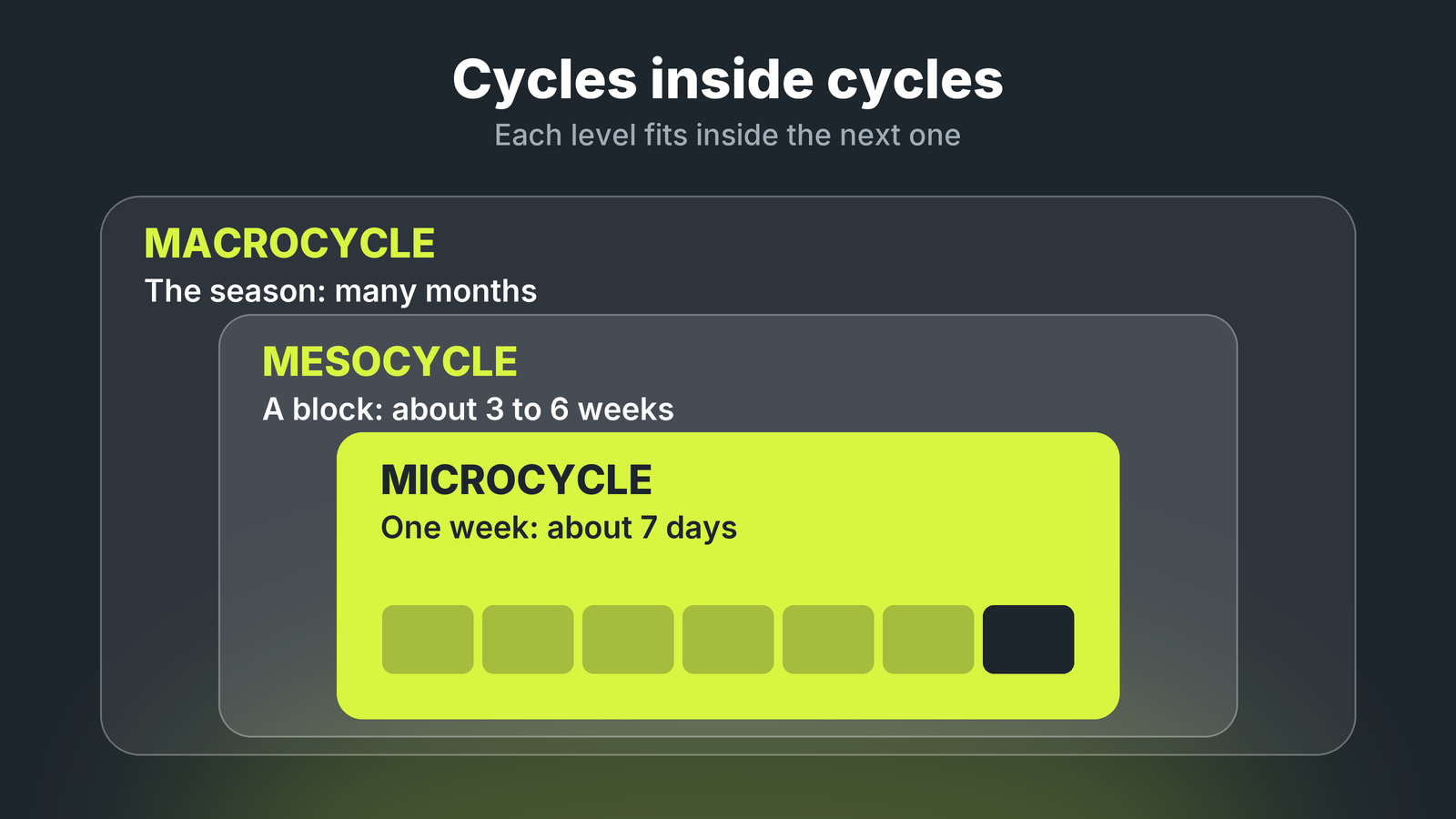
A microcycle is the shortest planned unit in a training plan, usually one week. It sits inside a mesocycle (a block of several weeks) and a macrocycle (the full season).
In team sports it is anchored to match day. Days are named by their distance from the game: MD-4 is four days before, MD-1 is the day before, MD+1 is the day after.
Because stress and recovery have to be balanced inside the week. Stacking hard days without recovery is what turns training into fatigue instead of fitness.
Sudden load spikes raise injury risk
Gabbett’s review of the training-injury prevention paradox links rapid increases in load, often expressed as the acute:chronic workload ratio, with a higher risk of injury. A smooth week protects athletes better than a week that jumps from light to heavy.
Overload without recovery causes trouble
The European College of Sport Science and ACSM consensus on overtraining describes how excessive overload combined with inadequate recovery can lead to prolonged maladaptation and performance decline. A microcycle alternates high-strain, lower-load and recovery days for this reason.
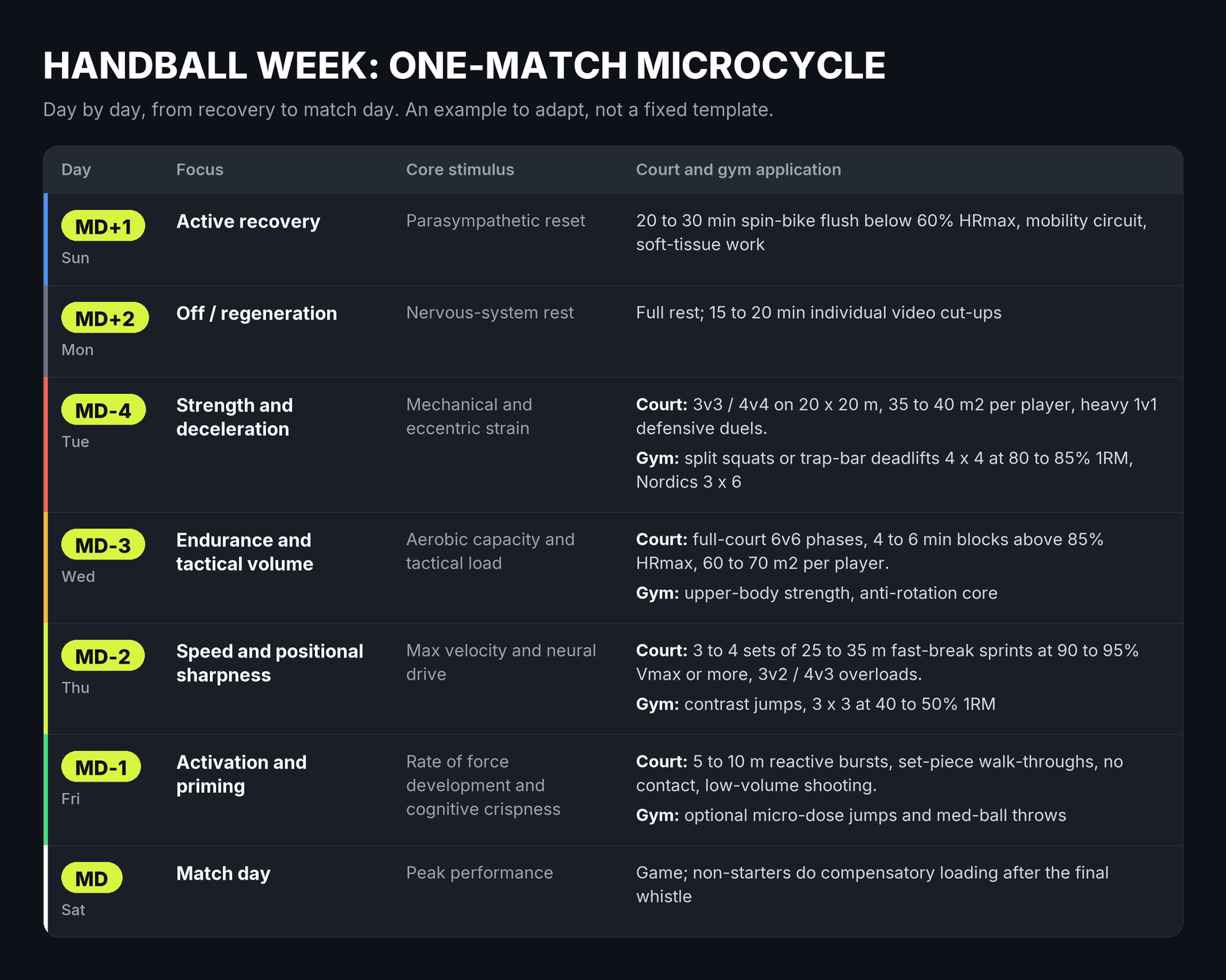
An effective week doses six stimuli, each on the day where it does the most good and the least harm. A drill is a tool, not the stimulus: the same 4v4 game can be a mechanical session or a metabolic one, depending on space, numbers and duration.
Mechanical and eccentric strain (MD-4)
Braking, cutting and landing load muscle and tendon. Research on the damaging nature of decelerations explains that accelerations and decelerations expose players to high mechanical stress, are important to monitor, and place different demands on the body. Placing this work early in the week leaves time to recover before the match.
Metabolic and aerobic capacity (MD-3)
Matches demand repeated high-intensity efforts. Large spaces and low player density allow sustained, match-realistic tempos and high cumulative distance. This is the day for tactical volume.
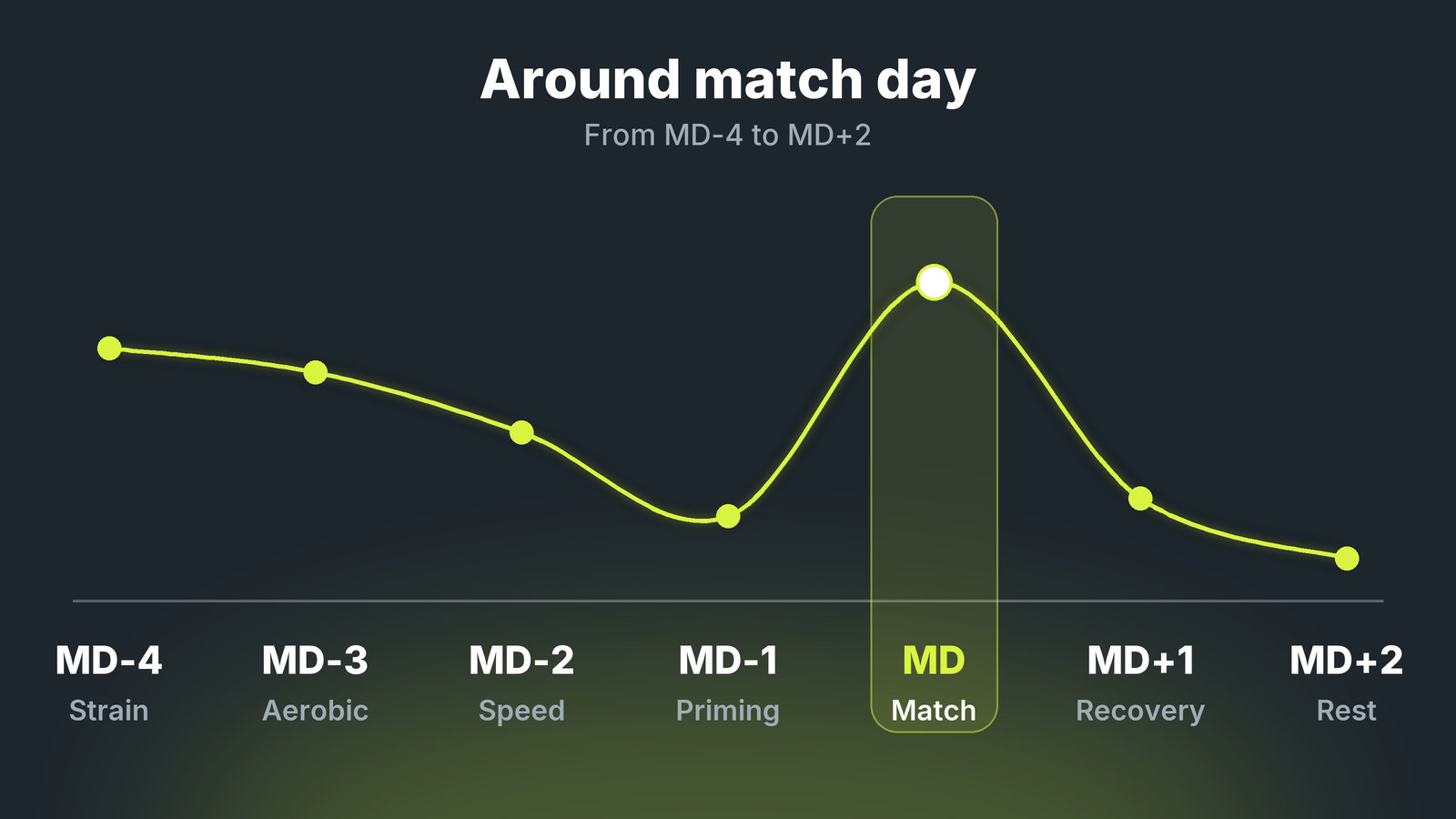
Maximal velocity exposure (MD-2)
Small-sided games rarely let players reach top speed, so open sprints need their own slot when athletes are fresh. In elite soccer, a study of high-speed running and sprinting found that large, rapid weekly increases in high-speed and sprint distance raised the odds of injury, while higher chronic load and better aerobic fitness offset that risk.
Neural priming (MD-1)
Short, low-volume, maximal-intent efforts prepare the nervous system without adding fatigue. The science is balanced. A review of factors that modulate post-activation potentiation describes a trade-off between potentiation and fatigue, and the evidence for performance gains is equivocal. A later paper on post-activation performance enhancement adds the same caution. Keep priming short and test what works for your athletes.
Tactical and cognitive load (MD-4 to MD-2)
Tactical work shapes the week as much as physical work. Move from demanding small-space games early in the week to clear, low-stress walk-throughs on MD-1.
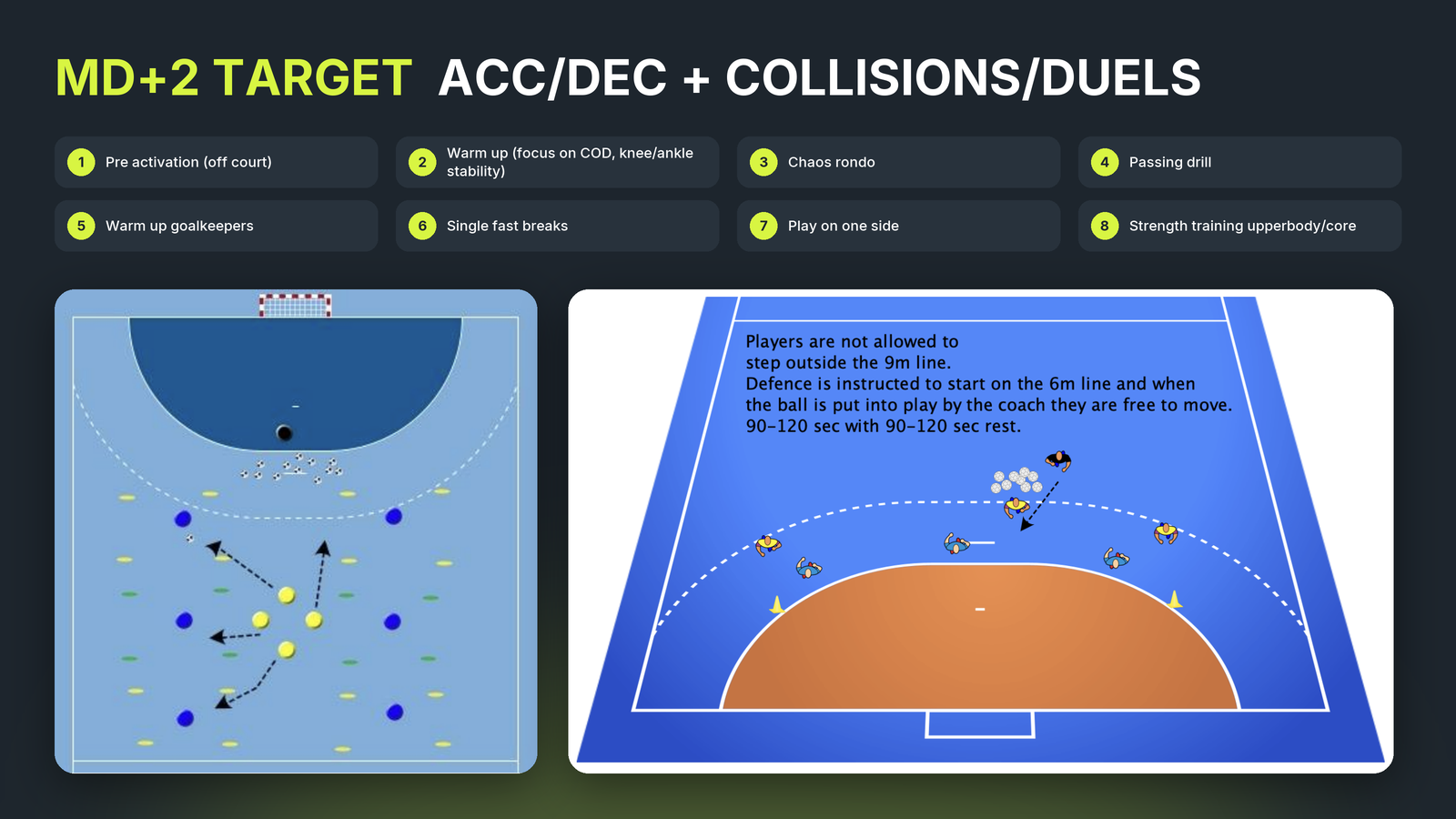
Reset (MD+1 and MD+2)
Recovery after the match is part of the plan. A review of post-match fatigue in soccer notes that with only 3 days between matches, full recovery may not be reached. Use non-impact flushing, mobility, sleep and nutrition.
Pontus Axell, Swedish Handball Federation’s former performance coach for youth national teams, the author of its sports physiological strategy, and now a coach educator. His federation uses XPS Network to store test results, document individual development plans, monitor training load and build exercise libraries for schools, coach education and the youth national teams.
In the XPS Webinar Building an efficient microcycle to improve performance, he walks through the foundations of building a training microcycle and how to bring that model to life using XPS Network, from tactical periodization frameworks to real session examples and training load monitoring.
Keep intensity high, cut volume and avoid new stress. The same idea applies to the last days of a weekly cycle.
The review of precompetition tapering strategies concludes that intensity should be maintained while volume is reduced and training frequency is reduced by no more than about 20%. In professional soccer, a study of weekly training load found that load declines from MD-4 to MD-1, which fits this logic.
Handball combines repeated sprints, collisions, hard braking and fast transitions. A systematic review of elite handball competition reports that players cover about 3,664 m per match (mean 3,664, SD 1,122).
The demands keep rising. In his article Building a performance pathway from youth to elite, Pontus Axell notes that the modern game has seen a marked trend toward increasing speed and heightened physical demands. The number of games in a season has also increased, which puts extra demands on players’ aerobic qualities (VO₂max) to cope with the volume of national and international competitions and to recover faster.
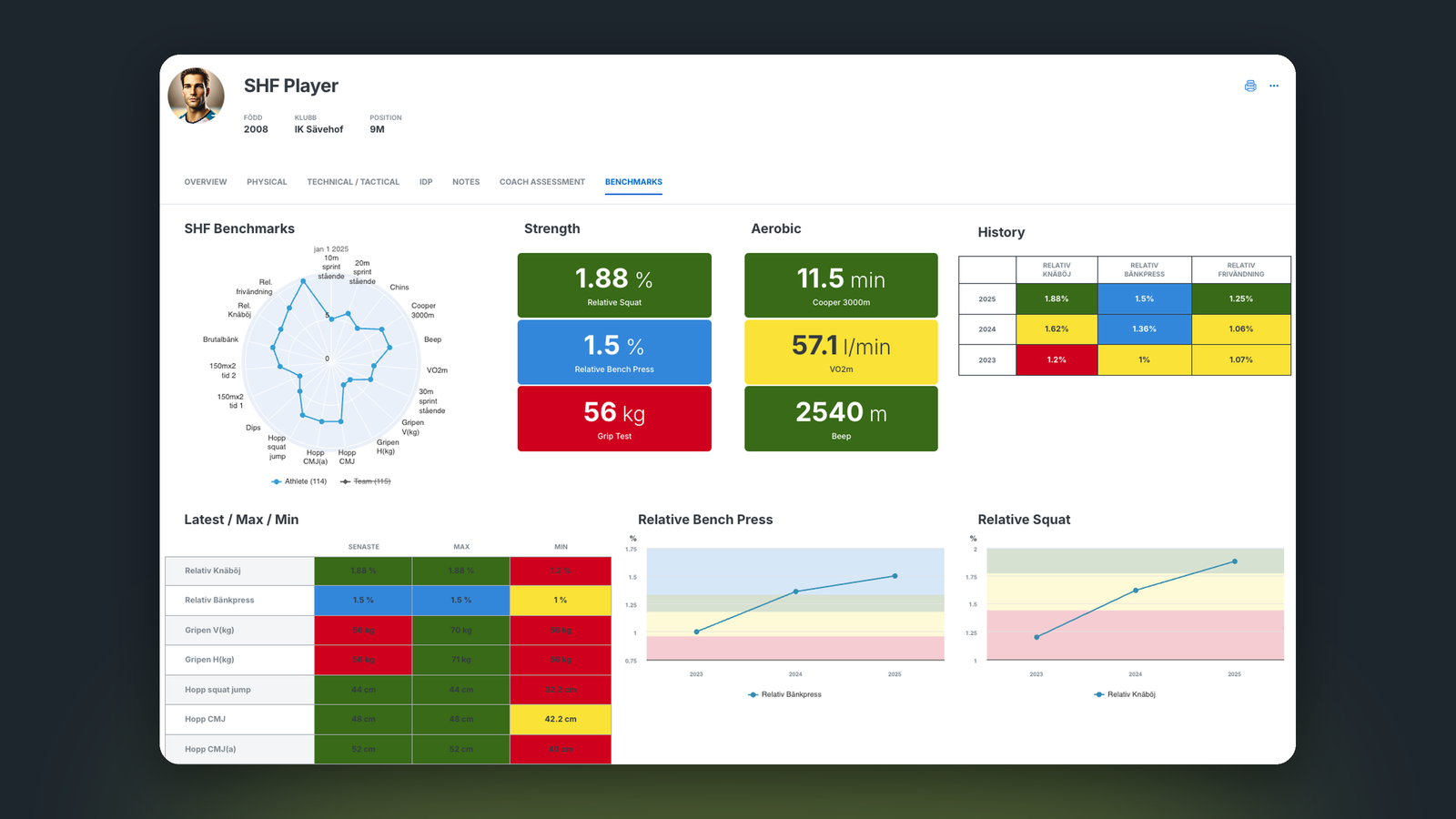
Demands also differ by position. A 2023 handball study found large differences in external load by playing position and by training day, while session RPE did not pick up those differences, so training should be tailored to the player.
The Swedish Handball Federation tailors its conditioning to each player. A conditioning card builds individual intervals in meters and km/h from two tests: maximum sprint speed (MSS), from a 40–50 m maximum sprint, and maximum aerobic speed (MAS), from a continuous 1600 m run. The range between the two is the anaerobic speed reserve (ASR). The card is automated in XPS, so after the two tests players can have their program uploaded to their app.
In the example below, the players run the same interval, 15/15 x 16 at yellow intensity, each over an individual distance based on ASR: 15 seconds of work, then 15 seconds of rest to move from the finish back to the start. For each turn in the work period, 5 meters come off the player’s distance to account for the time needed to decelerate and accelerate. That way no player is over- or under-stimulated.
Here is how the stimuli map onto a one-match week (Saturday match). Treat it as an example to adapt, not a fixed template.
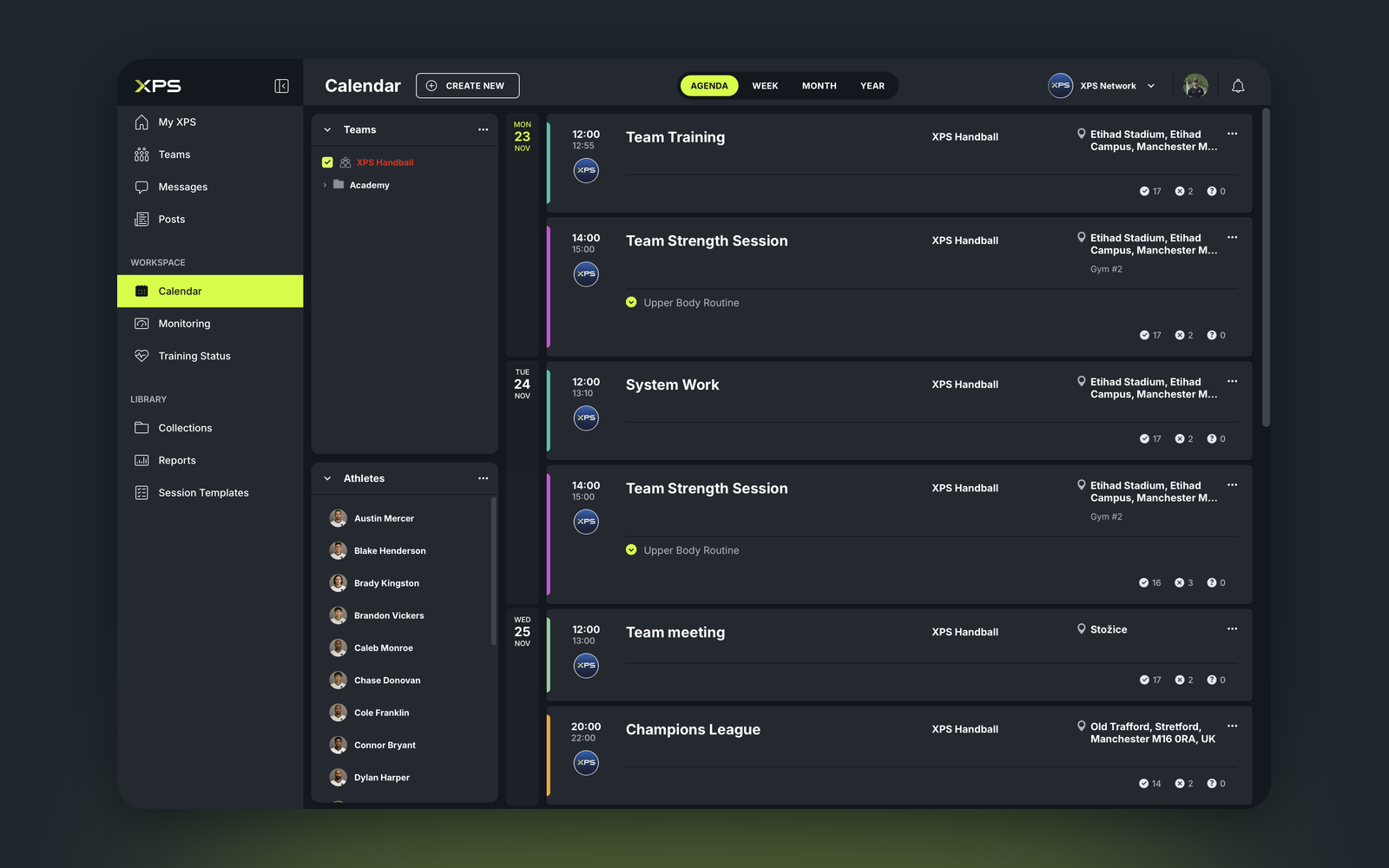
Give non-starters extra work to match the starters, and remove the heaviest sessions when two matches fall in one week.
Non-starters
The professional soccer study of weekly load by match day describes a compensatory session for players who did not play. Without it, their load lags behind the starters, and their risk grows if they are suddenly needed. Gabbett’s work on load and injury explains why a sudden jump is the danger.
Two games in one week
With a match on Wednesday and Saturday, drop the heavy MD-4 and MD-3 sessions. Use recovery, light tactical walk-throughs and low-volume priming between the games. The question becomes: how do we get this athlete ready to perform again?
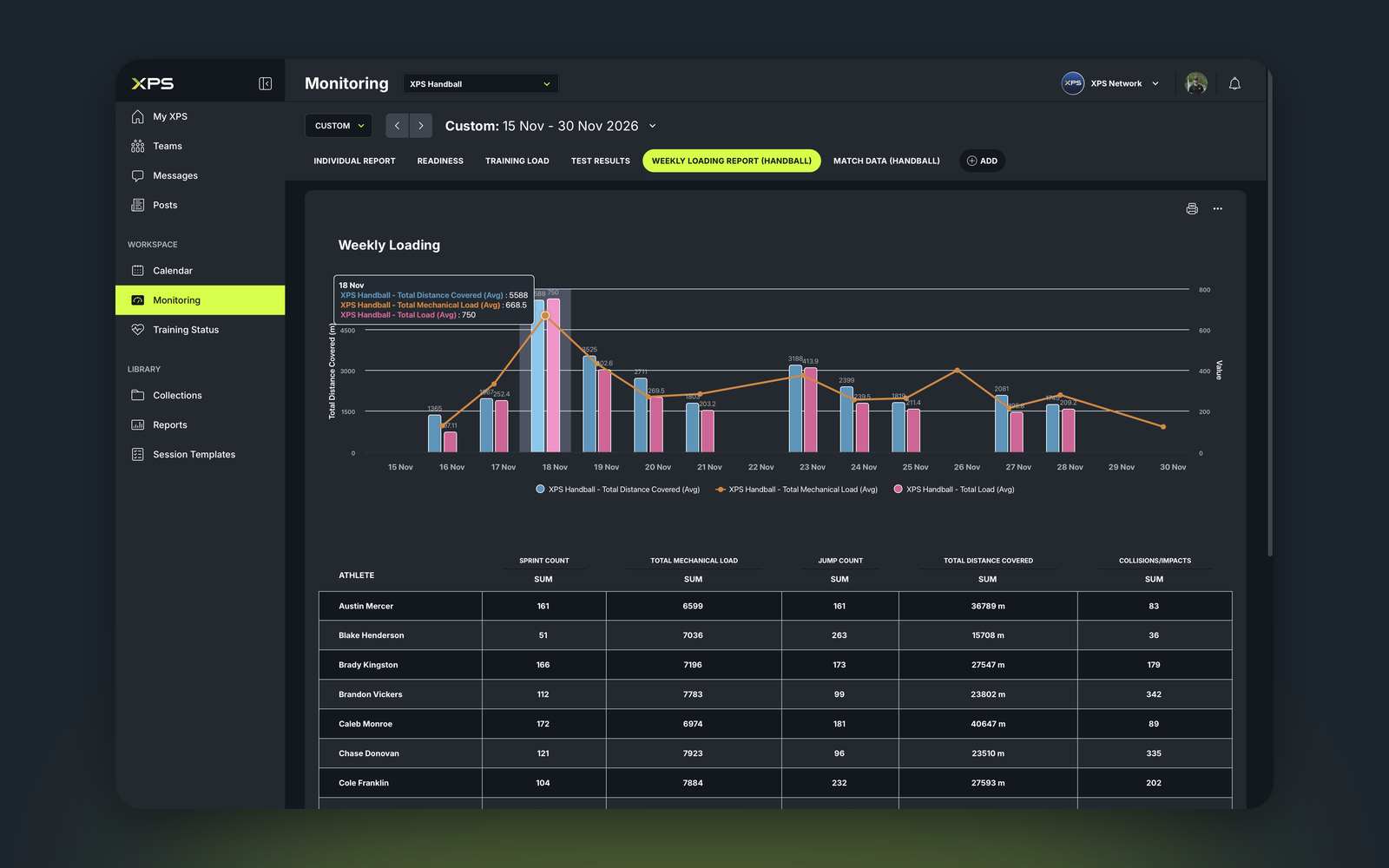
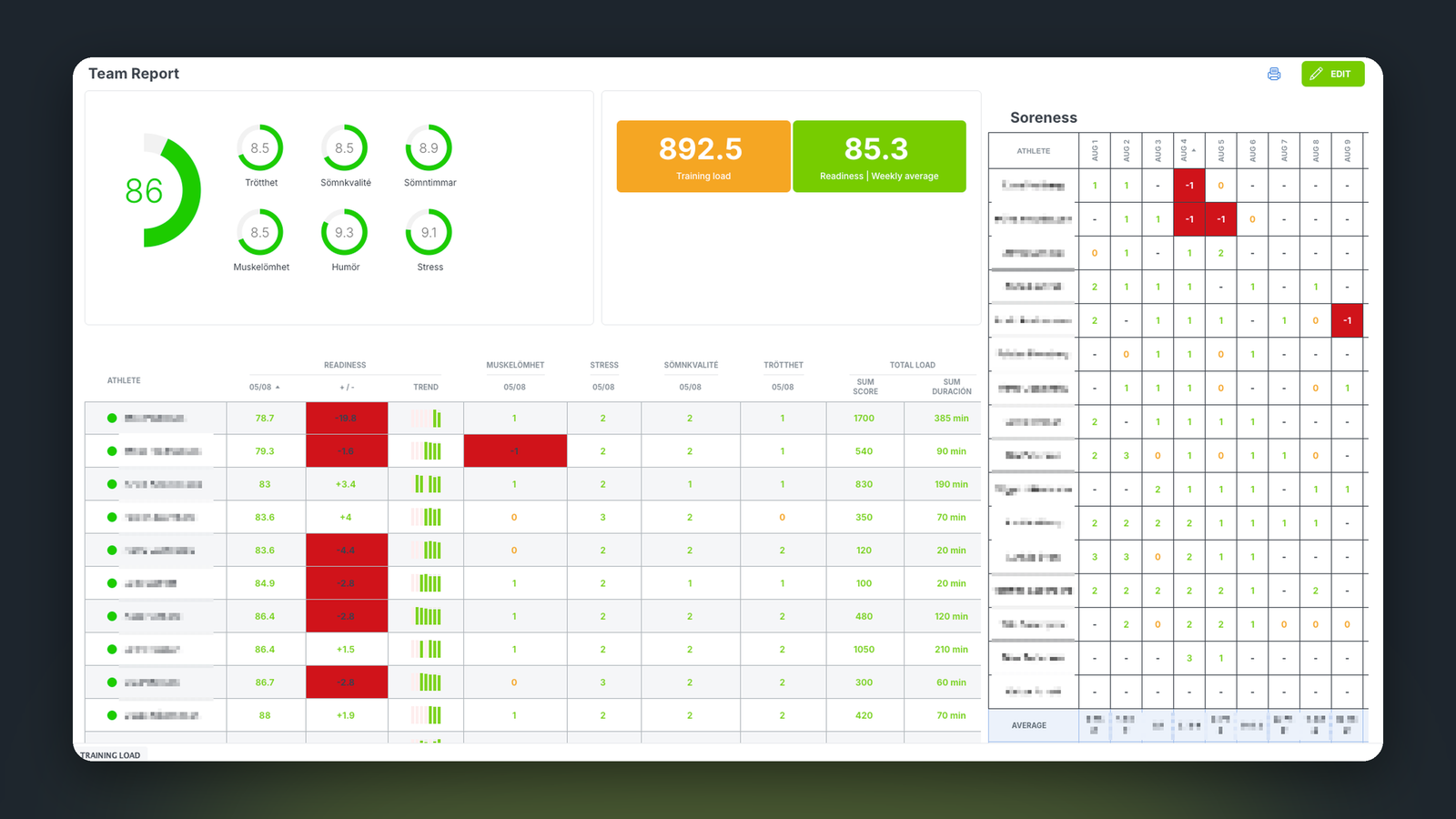
Start with the question the week needs to answer, then choose the measures. A review of monitoring training load notes that no single marker has been shown to be definitive, and a commentary on internal and external training load defines load as both an external and an internal component. So combine both views rather than relying on one number.
Useful questions for staff:
The goal is information that helps staff adjust tomorrow’s session before strain becomes injury.
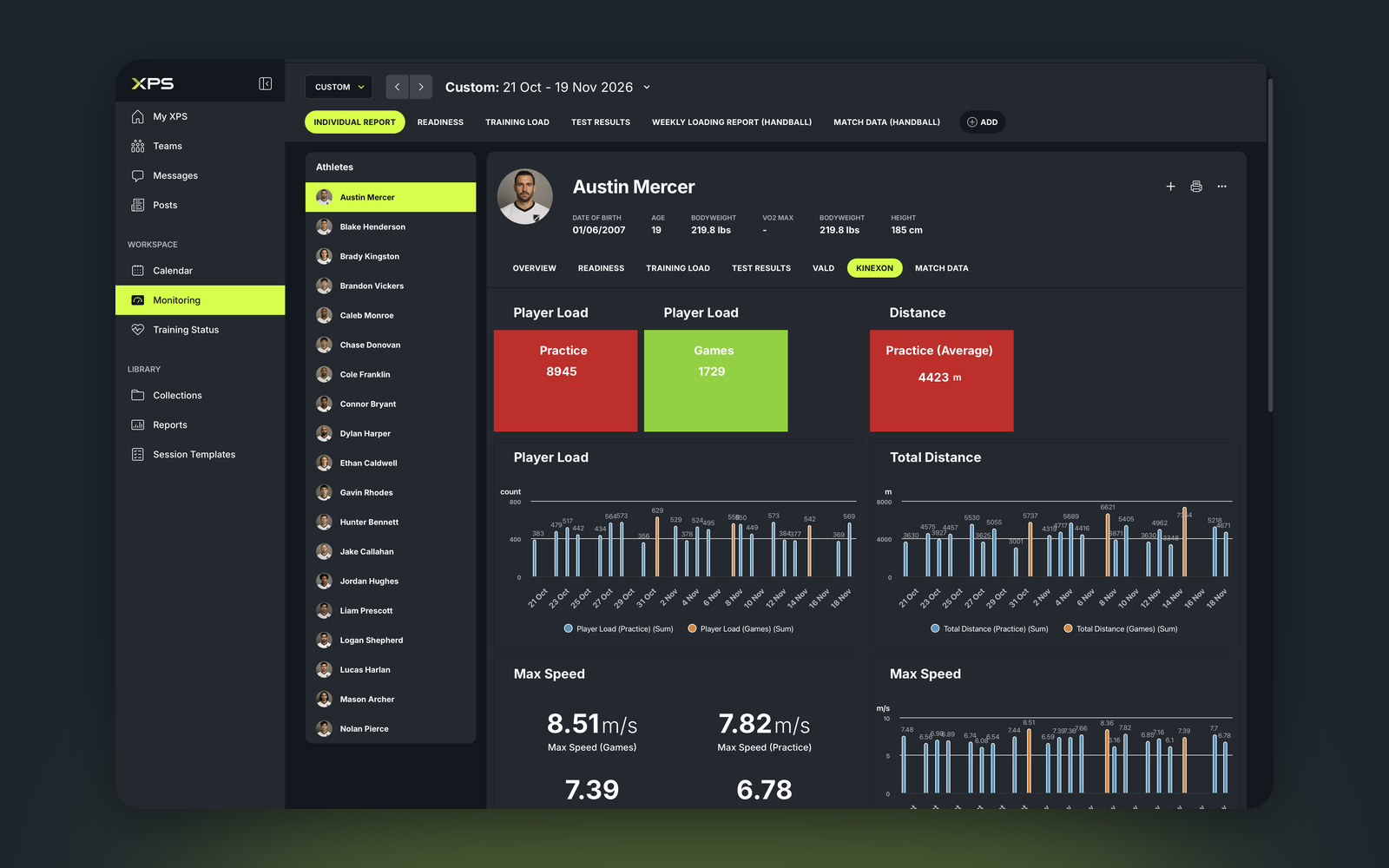
Pontus Axell describes readiness as a player’s physical and mental preparedness for training or competition. It can be assessed through metrics like heart rate variability, subjective wellness scores and neuromuscular tests, and regular monitoring lets coaches adjust training based on individual responses.
The Swedish Handball Federation does this with XPS. It monitors players leading up to championships (during pre-camp) and throughout them, to better understand their load, optimize their recovery and give their clubs comprehensive load data once the championships are over.
What is a microcycle in team sports?
A microcycle is a short training block, usually 7 days, planned around match day. It uses an MD- countdown to schedule recovery, loading, speed work and priming, so athletes reach the match prepared and fresh, with hard sessions early in the week and sharpening late.
How long is a microcycle?
Most often 7 days, because that matches the weekly match rhythm. When fixtures are congested, the block can be shorter or longer, so staff should plan around the real match dates instead of forcing a fixed seven day template onto every single week of the season.
What do MD-4, MD-3, MD-2 and MD-1 mean?
They count the days before match day (MD). MD-1 is the day before the game, MD-2 is two days before, and so on. MD+1 and MD+2 are the recovery days after the match. The labels help staff place each type of stimulus on the right day.
What is the most common mistake in microcycle planning?
Stacking load without a clear purpose for each day, so athletes arrive at match day tired. Large, rapid increases in load are linked to higher injury risk, so a smoother week with one main job per day, plus real recovery, is the safer plan for most squads.
How should a team taper before a match?
Keep intensity, reduce volume and keep training frequency close to normal. The tapering literature suggests cutting frequency by no more than about 20%. In practice this means short, sharp sessions on MD-2 and MD-1 instead of long, tiring ones, so athletes keep their rhythm and feel fresh.
How do you handle two games in one week?
Remove the heavy MD-4 and MD-3 sessions. Between matches use recovery, light tactical walk-throughs and low-volume priming. With only 3 days between matches full recovery may not be reached, so the aim is to get each athlete ready to perform again, not to build fitness.
How should non-starters train?
Players who do not play need compensatory work, such as extra high-speed running or small-sided games after the match or on MD+1. This keeps their weekly load close to the starters, so they are not exposed to a sudden jump in load when they are needed in the lineup.
What should coaches monitor during the week?
Start with the question the plan needs to answer, then pick the measures. Common ones are acceleration and deceleration counts, top speed, total distance, session RPE, jump tests, sleep and wellness scores. Combine external and internal load, and use the data to adjust the next session.
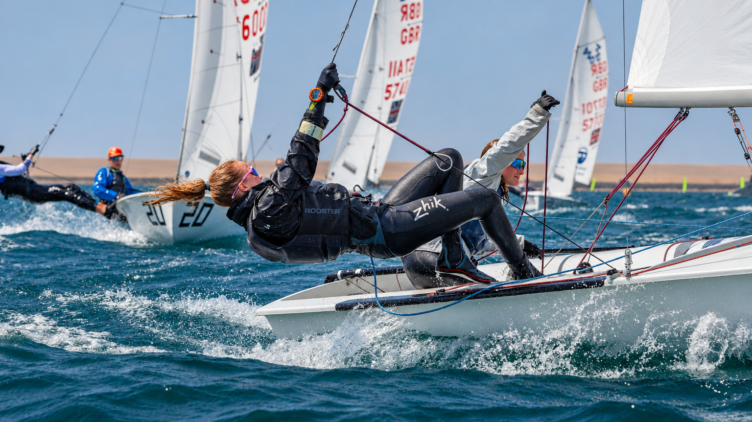
The Royal Yachting Association (RYA) uses XPS Network across the British Sailing Pathway to connect physical testing, athlete development...
Read More
We are at the final stage before releasing the new AI-powered features for XPS Network, and before anything goes...
Read More
A new connection brings KINEXON Sports player-tracking data into customizable XPS Reports, allowing coaches, performance staff and sports directors...
Read MoreThank you!
Our representative will get back to you soon with time suggestions for an online meeting.
If you have any questions contact us at support@sidelinesports.com
Schedule a short online meeting with our representative
Try free XPS 14-days trial right now No credit card required


